Fixed means proven.
Only a verifying connector can set a finding to verified. On CVE-2026-21445, 9 of 34 hosts are proven fixed and the vulnerability cannot close while 25 remain unproven, regardless of patch reports.
PYXA merges every scanner, penetration test and bug bounty finding into one queue, ranks it with the reasons shown, puts the work with an owner, and closes a finding only when your own scanner proves it fixed.
Community edition free under AGPL-3.0. Runs on one server inside your network.
Microsoft Intune reported srv-pay-04 patched. Tenable Nessus rescanned it and still found SMB signing not required. A workflow that closes on the deployment report would have closed this ticket the moment Intune reported it. PYXA kept it as a claim, and the rescan decided.
First seen by a scanner
Tenable Nessus · QID-2026-3390 · CVSS 8.1
Microsoft Intune reported fixed · KB5065219
Marked fixed by automation, not a person
Claimed · not proofTenable Nessus still found it after a reported fix
Same failure on srv-pay-05, -06 and -07
Verification failed · 4 of 4 hostsThe claim and the observation disagree about this host, and the observation decides. PYXA · finding detail, srv-pay-04
Collecting findings and scoring them is where remediation tools start. These six are where PYXA goes further, each enforced by the product rather than left to a setting.
Only a verifying connector can set a finding to verified. On CVE-2026-21445, 9 of 34 hosts are proven fixed and the vulnerability cannot close while 25 remain unproven, regardless of patch reports.
An unscanned asset produces no findings, which looks identical to a clean one. 154 of 4,322 assets have never been scanned. They read "unknown", sit hatched, and are left out of every percentage, with the exclusion stated.
Every control gets one of five answers: pass, fail, evidence incomplete, needs a person, or not applicable. Never a blended percentage. PCI-DSS 6.3.3 fails because 1,134 high and critical vulnerabilities have been open longer than 30 days.
PYXA runs on one server inside your network, air-gapped if needed. No PYXA cloud, no phone-home, and every outbound call is recorded.
Security and architecture → 05 · PricingProfessional is €9,000 per instance per year, in the open. Nothing is charged per asset, per finding or per seat, or twice when two sources report the same host.
Pricing → 06 · Free editionDeduplication across scanners, penetration tests, bug bounty, code and attack-surface findings is part of the free Community edition, not a paid upgrade.
Get started free →Findings arrive from scanners, penetration test reports, bug bounty programmes, code scanning and attack-surface tools, each in its own format with its own idea of severity. PYXA processes every one of them, consolidates the duplicates and ranks what is left on one scale.
 PYXAOne record per vulnerability, one scale
The same vulnerability reported by a scanner and by a pentester is one finding with two reports, not two tickets. On the demo estate, Tenable's 32 hosts and the pentest's 2 merged into one Apache Struts finding.
A pentest finding is scored like a scanner finding, with its reasons shown, and joins the same plans and deadlines. The broken access control on the quote API, which no scanner can see, scores 84; the default credentials on an admin console, 90.
Importing pentest and bug bounty files is in every edition; the penetration test engagements and retests screen is in Professional and Enterprise. The pentest and bug bounty data shown are fictional.
Each vulnerability is one row, whichever sources reported it. The demo estate carries 1,784 open vulnerabilities on 4,322 assets, ranked by risk.
Not "P0" but the contributions that made it P0. The score reads CISA KEV, EPSS, exploitation in the wild and your own asset context, and names every source it read, so the engineer asked to patch on a Friday can see why.
Selam Haile signs in to 13 host tasks, worst first: 4 failed verification, 9 inside their dates. Not a four-hundred-row export of the estate, and Jira, GLPI, TheHive or ServiceNow tickets follow the same lifecycle.
A patch report shows deployment. Only a verifying rescan closes the remediation. The emergency plan for CVE-2026-21445 holds 34 host tasks: 9 proven, 25 unproven, and it cannot complete until a scanner observes the rest.
Auto-triage puts new work in front of the right person the moment a sync lands, and AI drafts what people used to write by hand: the instructions, the plan, the knowledge entry. Both cut the time between detection and remediation. Neither can close a finding.
One host with Docker is all it needs. PYXA prepares the rest itself on first start, and the first sign-in opens a guided Setup.
The compose file and the web server's files, in one archive. No clone, no Git.
mkdir pyxa && cd pyxa
curl -sSL https://github.com/PYXA-Security/pyxa/archive/refs/heads/main.tar.gz \
| tar -xz --strip-components=1 pyxa-main/docker-compose.yml pyxa-main/nginxPYXA generates its own keys and a certificate, and serves HTTPS straight away.
docker compose up -dThen open https://localhost/ and sign in.
docker compose exec django python manage.py createsuperuserThe first sign-in opens Setup: required steps first, most with a one-click default. Connect a scanner from a form, or load the demo data shown on this site to look around first.
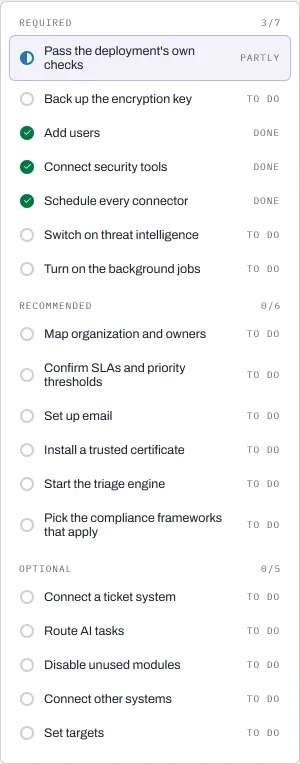
The browser warns once about the certificate PYXA signs for itself; the install guide shows how to replace it. Professional and Enterprise include a two-day install with your team, remote or on site.
The same product in three editions. No edition caps assets, findings or seats, and every price is published.
For security engineers and small teams who self-host.
Free
The whole loop, scanner to rescan-proven fix, under AGPL-3.0: scanners and imports, the risk score, action plans, Jira and 3 auto-triage rules.
Get started free Explore GitHubFor vulnerability managers running remediation across teams.
€9,000per instance per year
Less time on triage and reporting: unlimited auto-triage, every AI proposal, single sign-on, the board report and one framework of NIS2, TISAX or PCI DSS. Installed with your team in 2 days.
Get Professional Compare plansFor CISOs and regulated organisations.
from €18,000per instance per year
Governance at scale: all seven frameworks, access scope per person, ServiceNow, AI routed per task, a long-term support release and source-code escrow.
Request a demo Review the security architectureThe people who built the platform also test, audit and run vulnerability programs, with PYXA or with whatever you already run. Fixed scope, a written deliverable, practitioners only.
See the consulting services →External, internal, web application and Active Directory, with retests until the findings are closed.
Exposure assessment, then the program: ownership, priority policy, SLAs, campaigns and verified closure.
Gap assessments and readiness for NIS2, TISAX, the Cyber Resilience Act and PCI DSS.
Fractional support for the roadmap, the board narrative and the budget case.
A first call is 30 minutes with a practitioner, not a sales script.
Book a callRun the free edition on your own server today, or see PYXA on your own scanner data in a 30-minute demo.


